The Best Speaker Management Software for Conferences: 2026 Comparison Guide

We evaluated the top speaker management platforms on the market for you today.
Avatar Profile Picture
Mario Azuaje
March 5, 2026
8
min read
picture: Closeup of a microphone
Avatar Profile Photo
Mario Azuaje
12 September 2025
5 min read

Last updated: March 2026

The difference between a mind-blowing event and one that is just "meh" largely comes down to the caliber of your speakers — and the process behind getting them there.

But speaker management is not a single task. It's a chain of decisions, deadlines, emails, spreadsheets, portals, and last-minute changes that can consume hundreds of hours of your team's time before the first session even starts. The right software doesn't just organize that chaos — it eliminates most of it.

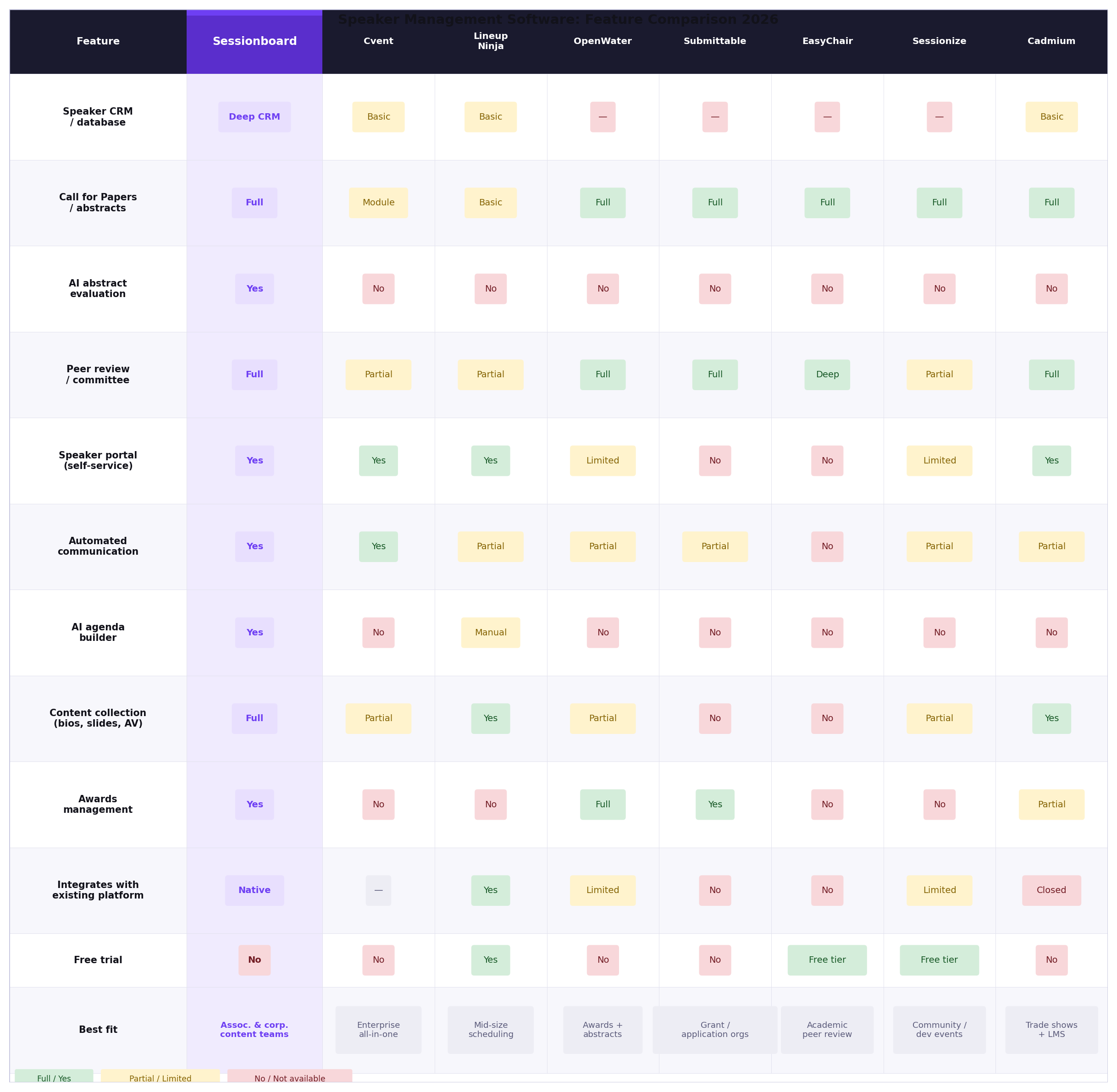
This guide compares the best speaker management software options for conference organizers in 2026: what each tool does well, who it's built for, and how to decide which one is right for your event programme.

Quick note on methodology: This comparison focuses on software purpose-built or well-suited for conference and association event teams managing speakers at scale. We've excluded general project management tools (Notion, Asana, Monday.com) and spreadsheet-based workarounds — not because they aren't popular, but because they don't address the full speaker lifecycle. If you're currently using one of those approaches and wondering whether it's time to move on, we've written dedicated guides: Sessionboard vs. all-in-one tools and Sessionboard vs. spreadsheets and manual workarounds.

What is speaker management software?

Speaker management software centralizes the entire process of finding, recruiting, onboarding, and supporting speakers across your event programme. A complete platform handles:

  • Discovery and recruitment — searching a database, sending outreach, tracking responses
  • Submissions and abstracts — accepting and evaluating session proposals
  • Speaker portals — giving speakers a self-service hub for deadlines and materials
  • Communication workflows — automated, personalized emails at each lifecycle stage
  • Content collection — bios, headshots, presentations, AV requirements
  • Agenda building — scheduling sessions, managing conflicts, publishing the programme
  • Post-event content — repurposing recordings and materials

The best tools don't just cover one or two of these phases — they cover the full lifecycle.

Why dedicated speaker management software matters in 2026

Most event teams still manage speakers in spreadsheets, shared inboxes, and ad-hoc folders. The consequences are predictable: missed deadlines, duplicate emails, lost materials, and exhausted staff.

The real cost is time. Sessionboard customers save an average of 177+ organizer hours per event. Clarion Events saved 3,013 hours across four events after moving to a dedicated system. That's not a marginal improvement — it's a transformation of what your team can focus on.

In 2026, there's an additional reason to invest in the right software: AI. The best platforms now use AI to accelerate abstract evaluation, surface scheduling conflicts, and optimize your agenda — tasks that previously required days of committee work.

The top speaker management software solutions in 2026

Option #1: Sessionboard

Best for: Association and corporate event content teams managing speakers at scale across multiple events

Sessionboard is purpose-built for event content teams. It is not an all-in-one event platform — it is a specialist tool that covers every stage of the speaker and content lifecycle: discovery, recruitment, abstract submission and evaluation, speaker portals, agenda building, and content management.

The key distinction from every other tool on this list: Sessionboard is designed to work alongside your existing event platform (Cvent, Bizzabo, Swoogo, and 10+ others) as a best-in-class specialist layer — not replace it.

What Sessionboard is known for:

Speaker CRM and database: A central, searchable database of every speaker across your entire event portfolio — with dynamic tagging, smart filtering, outreach history, and 360-degree profiles. No more hunting through past event folders or re-entering contacts from scratch each year.

Personalized speaker portal. Each speaker gets a branded, self-service portal to complete tasks, submit materials, track deadlines, and communicate with your team. Your staff stops chasing — the system does it for them.

Call for Papers and abstract managementfull submission management with configurable fields, multi-reviewer workflows, rubric-based scoring, and committee collaboration tools. You accept unlimited submissions; you only pay for accepted speakers.

AI Evaluators: AI-powered abstract review that scores and ranks submissions at scale. For events with hundreds or thousands of submissions, this dramatically reduces evaluation time and surfaces the strongest proposals faster.

AI Agenda Builder: Drag-and-drop scheduling with AI-assisted optimization. The system flags conflicts, suggests scheduling logic across tracks and rooms, and publishes real-time agenda updates to your event website.

Content Management: A centralized hub for all speaker materials — bios, headshots, presentations, AV requirements, and recorded sessions. Automated collection workflows mean your team no longer has to chase down files manually.

Awards and Studio Remix End-to-end awards and recognition programme management, plus AI-powered post-event content repurposing that turns session recordings into ongoing marketing assets.

What teams love:

  • The depth of the speaker lifecycle — no other tool covers as many stages in one platform
  • Native integrations with the event platforms teams already use
  • Meaningful time savings from day one: the 177-hour average is a documented result, not a marketing claim
  • AI that actually accelerates real work (abstract evaluation and agenda building) rather than being decorative

Worth knowing: Sessionboard is built for event content teams, not for logistics, registration, or exhibitor management. If your primary need is ticketing or floor plans, you'll still want a dedicated event platform alongside it.

Pricing: Modular. Pay only for accepted speakers, not all submissions. Request a demo or explore pricing.

Option #2: Cvent

Best for: Large enterprise events teams with significant budgets and a need for an all-in-one platform

Cvent is the dominant enterprise event management platform. It covers the full event stack: registration, hotel sourcing, marketing, mobile apps, attendee engagement, and — through its Speaker Resource Centre — basic speaker management.

What Cvent is known for:

  • Enterprise-grade event management with deep configuration options
  • Strong registration and hotel/venue sourcing capabilities
  • Large partner and integration ecosystem
  • Robust reporting and compliance tools

The trade-off: Cvent's speaker management is a module within a much larger platform. Teams with sophisticated content programmes often find that abstracts, evaluation workflows, and speaker communication are not as deep as a specialist tool. Many enterprise teams run Cvent for logistics and Sessionboard for speaker content for exactly this reason.

Pricing: Enterprise pricing, typicallya significant annual contract. A free trial is not available; pricing is available upon contacting sales.

Option #3: Lineup Ninja

Best for: Mid-size events that need flexible, visual scheduling and speaker management in one tool

Lineup Ninja is a specialist scheduling and speaker management platform designed to make building a conference programme visual, fast, and collaborative. Its drag-and-drop scheduler is particularly strong.

What Lineup Ninja is known for:

  • Intuitive drag-and-drop agenda builder
  • Real-time publishing to event websites and apps
  • Speaker invitation and onboarding workflows
  • Integration with major event platforms

The trade-off: Lineup Ninja's strengths are schedule management and speaker onboarding. Abstract submission management and speaker CRM depth are lighter compared to specialist tools. It works well for teams whose primary pain point is scheduling.

Pricing: Subscription-based, with pricing tiers by event size. Free trial available.

Option #4: OpenWater

Best for: Associations running awards programmes, grants, and abstract management for academic or professional communities

OpenWater is a submission and awards management platform built for associations that run formal review processes: abstract submissions, award nominations, grant applications, scholarship programmes, and more.

What OpenWater is known for:

  • Highly configurable submission and review workflows
  • Awards programme management (nominations, judging, winner notifications)
  • Strong compliance and reporting tools for associations
  • Multi-programme management across a portfolio of awards and events

The trade-off: OpenWater focuses on submission intake and review, not on the ongoing speaker relationship. Speaker portals, communication automation, content collection, and agenda building are not core to the platform. Teams that need both award management and full speaker lifecycle management often pair OpenWater with a specialist speaker tool or choose a platform that covers both.

Pricing: Custom pricing. Contact for a quote.

Option #5: Submittable

Best for: Organizations primarily running grants, applications, and submissions programmes that occasionally overlap with events

Submittable is a grant and application management platform that has become popular for call-for-papers workflows at some associations. It handles the intake and review phase of submissions well.

What Submittable is known for:

  • Clean, user-friendly submission forms
  • Solid review and approval workflows
  • Reporting and compliance tools
  • Strong brand recognition in the nonprofit and grant-making space

The trade-off: Submittable is a general-purpose application management tool — it is not event-specific. Speaker portals, agenda building, communication automation, content collection, and event-platform integrations are not part of the product. Teams that start with Submittable for CFP workflows often outgrow it when they need to manage the full speaker journey.

Pricing: Subscription plans starting at approximately $10,000/year for organizations.

Option #6: EasyChair

Best for: Academic conferences with large paper submission volumes and committee-heavy review processes

EasyChair is the dominant abstract and paper management tool for academic conferences — particularly in computer science, engineering, and related fields. It has been widely adopted because it is free for most use cases and handles the formal peer review process that academic communities expect.

What EasyChair is known for:

  • Free (with paid tiers) for academic conference use
  • Multi-track paper submission and peer review
  • Familiar with academic programme committees worldwide
  • Handles complex review assignments and bidding processes

The trade-off: EasyChair's interface and design reflect its origins — it is functional rather than modern. Speaker portals, communication workflows, content management, and agenda publishing are not part of the tool. It is a paper-review system, not a full speaker-management platform. Many academic events that use EasyChair for review still manage speakers manually after acceptance.

Pricing: Free for standard use; paid tiers for advanced features.

Option #7: Sessionize

Best for: Community-driven events, developer conferences, and open-source events with open CFP processes

Sessionize is a popular, lightweight CFP and speaker management tool with a strong following in the developer and community conference space. It is widely used for events like tech conferences, WordCamps, and user groups.

What Sessionize is known for:

  • Simple speaker submission experience
  • Free for small events; paid plans for larger programmes
  • Easy embed of session and speaker grids into event websites

The trade-off: Sessionize is designed for simplicity, which is both its strength and its limitation. Enterprise-level evaluation workflows, speaker CRM, content management, AI tools, and deep integrations are not part of the platform. It is excellent for community events with open CFPs; it is not designed for complex multi-track programmes or large-scale speaker management.

Pricing: Free for up to 50 speakers; paid plans start at ~$99/year.

Option #8: Cadmium

Best for: Trade shows and medical/health conferences that want an all-in-one platform covering exhibitors, LMS, abstracts, and speaker management

Cadmium is a full event tech stack targeting trade shows and professional associations. It covers exhibitor management, a learning management system (LMS), abstract management, speaker management, and digital content delivery — all in one suite.

What Cadmium is known for:

  • Strong exhibitor and trade show management alongside speaker tools
  • LMS and on-demand content delivery for continuing education (CE/CME)
  • Abstract management and evaluation workflows
  • All-in-one platform for organizations that want to consolidate vendors

The trade-off: Cadmium's breadth means its depth in any single area is a trade-off. Teams that need best-in-class speaker lifecycle management — with modern AI tools, deep CRM, and sophisticated communication workflows — often find that a specialist platform outperforms the speaker module within an all-in-one. Integration flexibility is also more limited since Cadmium is designed as a closed ecosystem.

Pricing: Enterprise pricing; contact for a quote.
How to decide which speaker management software is right for you

There is no single "best" option — the right tool depends on what your programme actually looks like. Here are the questions that matter most.

1. What phase of speaker management is your biggest pain point?

If you struggle most with finding and recruiting speakers, Sessionboard's Speaker CRM is the most purpose-built solution on the market — dynamic tagging, smart filtering, outreach history, and 360-degree profiles across your entire event portfolio. If your challenge is the formal review process, Sessionboard handles abstract submission, multi-reviewer workflows, and rubric-based scoring for professional associations; EasyChair is the standard for academic peer review specifically. If scheduling is your primary bottleneck, Sessionboard's AI Agenda Builder handles conflict detection and track optimization — and for teams that need a lighter scheduling-only tool, Lineup Ninja is worth a look.

2. Do you need to cover the full speaker lifecycle, or just one phase?

If you need to manage speakers from first discovery through post-event content, only a few platforms cover that full range. Sessionboard is designed for this. All-in-one platforms like Cvent and Cadmium cover more ground, but with shallower speaker-specific tools.

3. Are you replacing your event platform, or adding a specialist layer?

If you already use Cvent, Bizzabo, or Swoogo for logistics and registration, you do not need to replace them. Sessionboard integrates natively with all three, giving your content team a purpose-built tool without a full platform migration.

4. What is the nature of your event — association, corporate, academic, or community?

Sessionboard wins wherever speaker volume and agenda complexity are real factors — professional associations, corporate events, medical conferences, academic events with large submission volumes, and multi-track programmes. The deciding factor is not the event type; it's scale and complexity. If you're managing dozens of speakers with a straightforward agenda, simpler tools may be sufficient. If you're managing hundreds of speakers across multiple tracks with formal evaluation, content collection, and agenda publishing requirements, Sessionboard is built for exactly that. Community and developer events with small, open CFPs: Sessionize is a lightweight option. 

5. What does your submission volume look like?

For small events (under 50 speakers), Sessionize's free tier may be sufficient. Large programmes with hundreds of submissions: you need robust evaluation workflows, and ideally AI assistance — Sessionboard was built exactly for this.

6. What is your budget model?

Sessionboard charges only for accepted speakers — you do not pay for submissions that don't make it through the review process. For events with high submission volume and selective acceptance rates, this is a meaningful pricing advantage.

Frequently asked questions

What is the difference between speaker management software and event management software?

Event management software covers the full event stack: registration, ticketing, logistics, floor plans, hotel sourcing, mobile apps, and attendee engagement. Speaker management software focuses specifically on the content side — finding, recruiting, onboarding, and supporting speakers. Most large event teams use both an event management platform for logistics and a specialist speaker management tool for their content programme.

Can I use speaker management software alongside Cvent or Bizzabo?

Yes — this is actually the recommended approach for teams with sophisticated content programmes. Sessionboard, for example, integrates natively with Cvent, Bizzabo, Swoogo, and 10+ other event platforms. You keep your existing platform for registration and logistics; you use Sessionboard for speaker management, abstract submission, evaluation, and agenda building.

What is the best free speaker management software?

EasyChair is free for most academic conference uses and is the standard for academic peer review. Sessionize has a free tier for events with up to 50 speakers. For professional associations and corporate events, the investment in a purpose-built platform like Sessionboard typically pays for itself within the first event — the time savings alone are that significant.

How does AI help with speaker management?

The most practical AI applications in speaker management are abstract evaluation and agenda optimization. AI Evaluators (as in Sessionboard's implementation) can score and rank hundreds or thousands of submissions against defined criteria, reducing the time your review committee spends on initial screening. AI agenda builders can detect scheduling conflicts, suggest optimal session placement across tracks, and flag issues before they become problems on-site.

How long does it take to set up speaker management software?

This varies by platform and event complexity. Simple tools like Sessionize can be configured in an afternoon. Enterprise platforms like Cvent require structured onboarding. Sessionboard is designed for fast time-to-value — most teams run their first speaker portal within a week and achieve full workflow automation within the first event cycle.

What should I look for when evaluating speaker management software?

Start with the lifecycle coverage question: Does the tool support your entire speaker workflow, or just one phase? Then evaluate integration depth with your existing event platform, the speaker and reviewer experience (portals and submission forms), the communication and automation capabilities, and how the pricing model aligns with your submission vs. acceptance ratio.

The bottom line

Conference speaker management has become too complex, and the stakes too high, to manage in spreadsheets and inboxes. The right software does not just save your team time — it improves the speaker experience, raises content quality, and gives your programme team the capacity to focus on what matters: building a great event.

If you are an association or corporate event team running a multi-event programme with real content complexity, Sessionboard is the most purpose-built option on the market. Its speaker CRM depth, AI-powered evaluation and agenda tools, and integration-first architecture are designed specifically for teams like yours.

Schedule a demo today to see how Sessionboard fits your programme — or explore the platform to see what your team could look like with 177+ hours back per event.

time-icon
8
min read

The Best Speaker Management Software for Conferences: 2026 Comparison Guide

We evaluated the top speaker management platforms on the market for you today.

Last updated: March 2026

The difference between a mind-blowing event and one that is just "meh" largely comes down to the caliber of your speakers — and the process behind getting them there.

But speaker management is not a single task. It's a chain of decisions, deadlines, emails, spreadsheets, portals, and last-minute changes that can consume hundreds of hours of your team's time before the first session even starts. The right software doesn't just organize that chaos — it eliminates most of it.

This guide compares the best speaker management software options for conference organizers in 2026: what each tool does well, who it's built for, and how to decide which one is right for your event programme.

Quick note on methodology: This comparison focuses on software purpose-built or well-suited for conference and association event teams managing speakers at scale. We've excluded general project management tools (Notion, Asana, Monday.com) and spreadsheet-based workarounds — not because they aren't popular, but because they don't address the full speaker lifecycle. If you're currently using one of those approaches and wondering whether it's time to move on, we've written dedicated guides: Sessionboard vs. all-in-one tools and Sessionboard vs. spreadsheets and manual workarounds.

What is speaker management software?

Speaker management software centralizes the entire process of finding, recruiting, onboarding, and supporting speakers across your event programme. A complete platform handles:

  • Discovery and recruitment — searching a database, sending outreach, tracking responses
  • Submissions and abstracts — accepting and evaluating session proposals
  • Speaker portals — giving speakers a self-service hub for deadlines and materials
  • Communication workflows — automated, personalized emails at each lifecycle stage
  • Content collection — bios, headshots, presentations, AV requirements
  • Agenda building — scheduling sessions, managing conflicts, publishing the programme
  • Post-event content — repurposing recordings and materials

The best tools don't just cover one or two of these phases — they cover the full lifecycle.

Why dedicated speaker management software matters in 2026

Most event teams still manage speakers in spreadsheets, shared inboxes, and ad-hoc folders. The consequences are predictable: missed deadlines, duplicate emails, lost materials, and exhausted staff.

The real cost is time. Sessionboard customers save an average of 177+ organizer hours per event. Clarion Events saved 3,013 hours across four events after moving to a dedicated system. That's not a marginal improvement — it's a transformation of what your team can focus on.

In 2026, there's an additional reason to invest in the right software: AI. The best platforms now use AI to accelerate abstract evaluation, surface scheduling conflicts, and optimize your agenda — tasks that previously required days of committee work.

The top speaker management software solutions in 2026

Option #1: Sessionboard

Best for: Association and corporate event content teams managing speakers at scale across multiple events

Sessionboard is purpose-built for event content teams. It is not an all-in-one event platform — it is a specialist tool that covers every stage of the speaker and content lifecycle: discovery, recruitment, abstract submission and evaluation, speaker portals, agenda building, and content management.

The key distinction from every other tool on this list: Sessionboard is designed to work alongside your existing event platform (Cvent, Bizzabo, Swoogo, and 10+ others) as a best-in-class specialist layer — not replace it.

What Sessionboard is known for:

Speaker CRM and database: A central, searchable database of every speaker across your entire event portfolio — with dynamic tagging, smart filtering, outreach history, and 360-degree profiles. No more hunting through past event folders or re-entering contacts from scratch each year.

Personalized speaker portal. Each speaker gets a branded, self-service portal to complete tasks, submit materials, track deadlines, and communicate with your team. Your staff stops chasing — the system does it for them.

Call for Papers and abstract managementfull submission management with configurable fields, multi-reviewer workflows, rubric-based scoring, and committee collaboration tools. You accept unlimited submissions; you only pay for accepted speakers.

AI Evaluators: AI-powered abstract review that scores and ranks submissions at scale. For events with hundreds or thousands of submissions, this dramatically reduces evaluation time and surfaces the strongest proposals faster.

AI Agenda Builder: Drag-and-drop scheduling with AI-assisted optimization. The system flags conflicts, suggests scheduling logic across tracks and rooms, and publishes real-time agenda updates to your event website.

Content Management: A centralized hub for all speaker materials — bios, headshots, presentations, AV requirements, and recorded sessions. Automated collection workflows mean your team no longer has to chase down files manually.

Awards and Studio Remix End-to-end awards and recognition programme management, plus AI-powered post-event content repurposing that turns session recordings into ongoing marketing assets.

What teams love:

  • The depth of the speaker lifecycle — no other tool covers as many stages in one platform
  • Native integrations with the event platforms teams already use
  • Meaningful time savings from day one: the 177-hour average is a documented result, not a marketing claim
  • AI that actually accelerates real work (abstract evaluation and agenda building) rather than being decorative

Worth knowing: Sessionboard is built for event content teams, not for logistics, registration, or exhibitor management. If your primary need is ticketing or floor plans, you'll still want a dedicated event platform alongside it.

Pricing: Modular. Pay only for accepted speakers, not all submissions. Request a demo or explore pricing.

Option #2: Cvent

Best for: Large enterprise events teams with significant budgets and a need for an all-in-one platform

Cvent is the dominant enterprise event management platform. It covers the full event stack: registration, hotel sourcing, marketing, mobile apps, attendee engagement, and — through its Speaker Resource Centre — basic speaker management.

What Cvent is known for:

  • Enterprise-grade event management with deep configuration options
  • Strong registration and hotel/venue sourcing capabilities
  • Large partner and integration ecosystem
  • Robust reporting and compliance tools

The trade-off: Cvent's speaker management is a module within a much larger platform. Teams with sophisticated content programmes often find that abstracts, evaluation workflows, and speaker communication are not as deep as a specialist tool. Many enterprise teams run Cvent for logistics and Sessionboard for speaker content for exactly this reason.

Pricing: Enterprise pricing, typicallya significant annual contract. A free trial is not available; pricing is available upon contacting sales.

Option #3: Lineup Ninja

Best for: Mid-size events that need flexible, visual scheduling and speaker management in one tool

Lineup Ninja is a specialist scheduling and speaker management platform designed to make building a conference programme visual, fast, and collaborative. Its drag-and-drop scheduler is particularly strong.

What Lineup Ninja is known for:

  • Intuitive drag-and-drop agenda builder
  • Real-time publishing to event websites and apps
  • Speaker invitation and onboarding workflows
  • Integration with major event platforms

The trade-off: Lineup Ninja's strengths are schedule management and speaker onboarding. Abstract submission management and speaker CRM depth are lighter compared to specialist tools. It works well for teams whose primary pain point is scheduling.

Pricing: Subscription-based, with pricing tiers by event size. Free trial available.

Option #4: OpenWater

Best for: Associations running awards programmes, grants, and abstract management for academic or professional communities

OpenWater is a submission and awards management platform built for associations that run formal review processes: abstract submissions, award nominations, grant applications, scholarship programmes, and more.

What OpenWater is known for:

  • Highly configurable submission and review workflows
  • Awards programme management (nominations, judging, winner notifications)
  • Strong compliance and reporting tools for associations
  • Multi-programme management across a portfolio of awards and events

The trade-off: OpenWater focuses on submission intake and review, not on the ongoing speaker relationship. Speaker portals, communication automation, content collection, and agenda building are not core to the platform. Teams that need both award management and full speaker lifecycle management often pair OpenWater with a specialist speaker tool or choose a platform that covers both.

Pricing: Custom pricing. Contact for a quote.

Option #5: Submittable

Best for: Organizations primarily running grants, applications, and submissions programmes that occasionally overlap with events

Submittable is a grant and application management platform that has become popular for call-for-papers workflows at some associations. It handles the intake and review phase of submissions well.

What Submittable is known for:

  • Clean, user-friendly submission forms
  • Solid review and approval workflows
  • Reporting and compliance tools
  • Strong brand recognition in the nonprofit and grant-making space

The trade-off: Submittable is a general-purpose application management tool — it is not event-specific. Speaker portals, agenda building, communication automation, content collection, and event-platform integrations are not part of the product. Teams that start with Submittable for CFP workflows often outgrow it when they need to manage the full speaker journey.

Pricing: Subscription plans starting at approximately $10,000/year for organizations.

Option #6: EasyChair

Best for: Academic conferences with large paper submission volumes and committee-heavy review processes

EasyChair is the dominant abstract and paper management tool for academic conferences — particularly in computer science, engineering, and related fields. It has been widely adopted because it is free for most use cases and handles the formal peer review process that academic communities expect.

What EasyChair is known for:

  • Free (with paid tiers) for academic conference use
  • Multi-track paper submission and peer review
  • Familiar with academic programme committees worldwide
  • Handles complex review assignments and bidding processes

The trade-off: EasyChair's interface and design reflect its origins — it is functional rather than modern. Speaker portals, communication workflows, content management, and agenda publishing are not part of the tool. It is a paper-review system, not a full speaker-management platform. Many academic events that use EasyChair for review still manage speakers manually after acceptance.

Pricing: Free for standard use; paid tiers for advanced features.

Option #7: Sessionize

Best for: Community-driven events, developer conferences, and open-source events with open CFP processes

Sessionize is a popular, lightweight CFP and speaker management tool with a strong following in the developer and community conference space. It is widely used for events like tech conferences, WordCamps, and user groups.

What Sessionize is known for:

  • Simple speaker submission experience
  • Free for small events; paid plans for larger programmes
  • Easy embed of session and speaker grids into event websites

The trade-off: Sessionize is designed for simplicity, which is both its strength and its limitation. Enterprise-level evaluation workflows, speaker CRM, content management, AI tools, and deep integrations are not part of the platform. It is excellent for community events with open CFPs; it is not designed for complex multi-track programmes or large-scale speaker management.

Pricing: Free for up to 50 speakers; paid plans start at ~$99/year.

Option #8: Cadmium

Best for: Trade shows and medical/health conferences that want an all-in-one platform covering exhibitors, LMS, abstracts, and speaker management

Cadmium is a full event tech stack targeting trade shows and professional associations. It covers exhibitor management, a learning management system (LMS), abstract management, speaker management, and digital content delivery — all in one suite.

What Cadmium is known for:

  • Strong exhibitor and trade show management alongside speaker tools
  • LMS and on-demand content delivery for continuing education (CE/CME)
  • Abstract management and evaluation workflows
  • All-in-one platform for organizations that want to consolidate vendors

The trade-off: Cadmium's breadth means its depth in any single area is a trade-off. Teams that need best-in-class speaker lifecycle management — with modern AI tools, deep CRM, and sophisticated communication workflows — often find that a specialist platform outperforms the speaker module within an all-in-one. Integration flexibility is also more limited since Cadmium is designed as a closed ecosystem.

Pricing: Enterprise pricing; contact for a quote.

How to decide which speaker management software is right for you

There is no single "best" option — the right tool depends on what your programme actually looks like. Here are the questions that matter most.

1. What phase of speaker management is your biggest pain point?

If you struggle most with finding and recruiting speakers, Sessionboard's Speaker CRM is the most purpose-built solution on the market — dynamic tagging, smart filtering, outreach history, and 360-degree profiles across your entire event portfolio. If your challenge is the formal review process, Sessionboard handles abstract submission, multi-reviewer workflows, and rubric-based scoring for professional associations; EasyChair is the standard for academic peer review specifically. If scheduling is your primary bottleneck, Sessionboard's AI Agenda Builder handles conflict detection and track optimization — and for teams that need a lighter scheduling-only tool, Lineup Ninja is worth a look.

2. Do you need to cover the full speaker lifecycle, or just one phase?

If you need to manage speakers from first discovery through post-event content, only a few platforms cover that full range. Sessionboard is designed for this. All-in-one platforms like Cvent and Cadmium cover more ground, but with shallower speaker-specific tools.

3. Are you replacing your event platform, or adding a specialist layer?

If you already use Cvent, Bizzabo, or Swoogo for logistics and registration, you do not need to replace them. Sessionboard integrates natively with all three, giving your content team a purpose-built tool without a full platform migration.

4. What is the nature of your event — association, corporate, academic, or community?

Sessionboard wins wherever speaker volume and agenda complexity are real factors — professional associations, corporate events, medical conferences, academic events with large submission volumes, and multi-track programmes. The deciding factor is not the event type; it's scale and complexity. If you're managing dozens of speakers with a straightforward agenda, simpler tools may be sufficient. If you're managing hundreds of speakers across multiple tracks with formal evaluation, content collection, and agenda publishing requirements, Sessionboard is built for exactly that. Community and developer events with small, open CFPs: Sessionize is a lightweight option. 

5. What does your submission volume look like?

For small events (under 50 speakers), Sessionize's free tier may be sufficient. Large programmes with hundreds of submissions: you need robust evaluation workflows, and ideally AI assistance — Sessionboard was built exactly for this.

6. What is your budget model?

Sessionboard charges only for accepted speakers — you do not pay for submissions that don't make it through the review process. For events with high submission volume and selective acceptance rates, this is a meaningful pricing advantage.

Frequently asked questions

What is the difference between speaker management software and event management software?

Event management software covers the full event stack: registration, ticketing, logistics, floor plans, hotel sourcing, mobile apps, and attendee engagement. Speaker management software focuses specifically on the content side — finding, recruiting, onboarding, and supporting speakers. Most large event teams use both an event management platform for logistics and a specialist speaker management tool for their content programme.

Can I use speaker management software alongside Cvent or Bizzabo?

Yes — this is actually the recommended approach for teams with sophisticated content programmes. Sessionboard, for example, integrates natively with Cvent, Bizzabo, Swoogo, and 10+ other event platforms. You keep your existing platform for registration and logistics; you use Sessionboard for speaker management, abstract submission, evaluation, and agenda building.

What is the best free speaker management software?

EasyChair is free for most academic conference uses and is the standard for academic peer review. Sessionize has a free tier for events with up to 50 speakers. For professional associations and corporate events, the investment in a purpose-built platform like Sessionboard typically pays for itself within the first event — the time savings alone are that significant.

How does AI help with speaker management?

The most practical AI applications in speaker management are abstract evaluation and agenda optimization. AI Evaluators (as in Sessionboard's implementation) can score and rank hundreds or thousands of submissions against defined criteria, reducing the time your review committee spends on initial screening. AI agenda builders can detect scheduling conflicts, suggest optimal session placement across tracks, and flag issues before they become problems on-site.

How long does it take to set up speaker management software?

This varies by platform and event complexity. Simple tools like Sessionize can be configured in an afternoon. Enterprise platforms like Cvent require structured onboarding. Sessionboard is designed for fast time-to-value — most teams run their first speaker portal within a week and achieve full workflow automation within the first event cycle.

What should I look for when evaluating speaker management software?

Start with the lifecycle coverage question: Does the tool support your entire speaker workflow, or just one phase? Then evaluate integration depth with your existing event platform, the speaker and reviewer experience (portals and submission forms), the communication and automation capabilities, and how the pricing model aligns with your submission vs. acceptance ratio.

The bottom line

Conference speaker management has become too complex, and the stakes too high, to manage in spreadsheets and inboxes. The right software does not just save your team time — it improves the speaker experience, raises content quality, and gives your programme team the capacity to focus on what matters: building a great event.

If you are an association or corporate event team running a multi-event programme with real content complexity, Sessionboard is the most purpose-built option on the market. Its speaker CRM depth, AI-powered evaluation and agenda tools, and integration-first architecture are designed specifically for teams like yours.

Schedule a demo today to see how Sessionboard fits your programme — or explore the platform to see what your team could look like with 177+ hours back per event.

Mario Azuaje

Product Marketing

Sign up for our newsletter

Stay up to date with our latest news

Subscribe to product updates
Subscription confirmed.
Something went wrong. Please try again later.
Optimize Your Event Management, Start Today.

See how real teams simplify speaker management, scale content operations,
and run smoother events with Sessionboard.